What Polish rap raps about
What is rap about? How has it changed over the years? Which rappers have the richest vocabulary? In 2016 I counted all of that while learning to program. What does Polish rap rap about ten years later?
English edition of a page first written in Polish. The original: sawka.pro/ranking. The lyrics stay in Polish, with my rough translations; the counting runs on the Polish.
Noce i dni kładę słowa na bit
To owoce chwil, które przeżywałem wczoraj i dziś
Nights and days I lay words on the beat. They are the fruit of moments I lived yesterday and today.
Polish rap for outsiders
Polish hip-hop starts in the early 1990s. Liroy's „Alboom” (1995), with the single „Scyzoryk” (Penknife), sold 500,000 copies according to Polish Wikipedia. In Katowice, Kaliber 44 forms in 1993 and releases „Księga Tajemnicza. Prolog” in 1996. Magik leaves it to co-found Paktofonika, whose debut „Kinematografia” comes out in 2000. He dies in December that year. In Warsaw, Molesta Ewenement forms in 1995; it is counted among the founders of street rap.
Twenty years later rap tops the sales charts. In five of the ten years from 2016 to 2025 the best-selling album of the year in Poland was a rap album: O.S.T.R. in 2016, Quebonafide in 2017, 2020 and 2025, Taco Hemingway in 2023. That is the annual ZPAV/OLiS sales chart, the official one.
A few words you will meet on every chart. Blok is the concrete apartment block, osiedle the housing estate made of them, the home turf of 90s rap. Hajs, kasa and siano all mean cash. Kurwa is the all-purpose swear word, literally “whore”. Mordo means bro, literally “mug”.
One thing about the counting. Polish bends its words. Dom (house) has ten forms: dom, domu, domowi, domem, domie, domy, domów, domom, domami, domach. Count raw forms and a rapper scores points for grammar. So every word goes back to its dictionary form, its lemma, before anything is counted: „szedłem” (I walked), „idzie” (he goes) and „iść” (to go) are one word. The English glosses next to the words are machine-drafted and checked by hand where the slang gets tricky. Read them as hints.
The meme, checked
A meme about Polish rap goes around. Then: the whole estate on the dole, stealing ten złoty for food, sharing one sofa bed with your brother, a father who drank himself to death. Now: swapping one car for the next, a 50,000 złoty kitchen island, depression in the Maldives and sushi for dinner.
I counted every frame. I split the history in half: songs up to 2014 and from 2015. That is roughly half of all dated songs, and the point after which the data changes most.
The “now” side holds. From 2015 cars come up twice as often, cribs, villas and apartments more than twice, exotic trips two and a half times. Depression, therapy and meds grow most, almost three times. Cars and cribs speed up once more around 2018. I did not find a kitchen island in Polish rap even once.
The “then” side did not go away. Poverty, theft and the father drop only a little; drinking even rises slightly. Block, estate and poverty together stay flat: the same before 2015 and after, and in both halves half again as often as in the 90s.
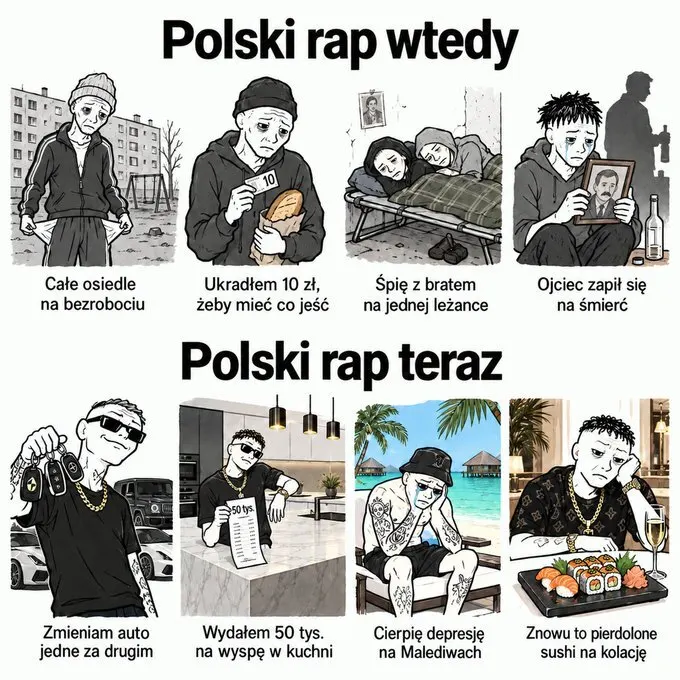
Rap did not stop rapping about the estate. It added a Porsche and a therapist.
×2.7depression, therapy and meds per 10,000 words: 0.85 up to 2014, 2.28 from 2015
Show table
Year by year: the biggest changes
Show table
The phone rings more and more
The phone, together with calling, comes up in Polish rap almost four times as often today as in the 90s. Calling itself grows fastest: „dzwoni” (it’s ringing), „dzwonię” (I’m calling), „zadzwoń” (call). The rise comes between 2010 and 2016, then it flattens. The word „telefon” alone still comes up less than half as often as the car.
What people do with it is more interesting. Up to 2009 the words next to the phone are „odbieram” (I pick up) and „halo” (hello). From 2015: „wyciszam” (I mute), „wyłączam” (I switch off), „tryb” (mode).
The phone stopped being something you answer. It became something you silence.
×3.8phone and calling: 2020–26 against the 90s
After 2020, chains and watches grow fastest. The TV set drops only by a third; football and cigarettes stay flat.
The street, though, is fading. In the 90s it came up two and a half times as often as today, and the district ten times as often. Rap also stopped talking about its own gear: the microphone is three and a half times rarer than in the 90s and five and a half times rarer than at its peak in the early 2000s. Cassette and vinyl fell more than threefold from that peak. The car rises; bus and tram fall by more than half.
Things and places, era by era
What I count
Show table
Less “we”, more “me”
Up to 2015 there were about three „ja” (I) for every „my” (we). After that, almost five. The word „ja” itself does not change. What grows is „mnie” and „mi”, me and to me.
Quotes · “we” up to 2009, “I” from 2015
1999 we
My wszyscy jesteśmy z tej samej gliny
We are all made of the same clay
Kaliber 44, „Konfrontacje” 2000 we
My z ziomkami robimy co się da, żeby było lepsze życie
Me and my homies do what we can for a better life
WWO, „Jeszcze będzie czas” 2004 we
Razem zburzymy każdą ścianę między nami
Together we’ll tear down every wall between us
Hemp Gru, „Sami swoi” 2006 we
My chcemy żyć to nie przestępstwo
We want to live, that’s no crime
Pono, „Policyjne miasto” 2007 we
Mówią mieliśmy ambicje ale mijało nas szczęście
They say we had ambitions, but luck kept passing us by
Eldo, „Ferajny” 2009 we
Idziemy po swoje, dla nas bloki są za małe
We’re going for what’s ours, the blocks are too small for us
Donguralesko, „Idziemy Po Swoje” 2015 I
Nie zjadają mnie nerwy, to ja zjadam nerwy; pycha
My nerves don’t eat me, I eat my nerves; pride
Quebonafide, „Powszechny i śmiertelny” 2016 I
Jednak czuję strach, który mi do serca silnie przywarł
Still I feel a fear that has clung hard to my heart
Taco Hemingway, „Krwawa jesień” 2016 I
Słońce zakryły rolety, boli mnie głowa i serce mi pęka
The blinds have covered the sun, my head hurts and my heart is breaking
KęKę, „Nic już nie muszę” 2019 I
Chciało mi się płakać a łzy wycierałem w kaptur
I felt like crying, and I wiped the tears on my hood
Żabson, „Kaptur” 2020 I
Siedziałem samotny na dnie i dobrze mi było na dole
I sat alone at the bottom, and it felt good down there
Szpaku, „Ćmy” 2022 I
Czasem nie mogę oddychać, czuję, że dusi mnie strach
Sometimes I can’t breathe, I feel fear choking me
Kinny Zimmer, „Jezioro”
More and more, the rapper talks about what happens to him, not about what he does.
5 : 1“I” per one “we” from 2020; up to 2009 it was 3 : 1
More cash, the same cash
My first count suggested a neat thesis: back then cash sat in the lyrics next to the wallet and earning, today next to fame, whips and the pool. I counted more carefully and the thesis falls.
Since 2015 Polish rap talks about money a fifth more often. But the things next to it are the same as before. There is even slightly more earning; spending and family stay flat; poverty barely moves. Luxury next to money grew, but it grew across all of rap, not just there.
„Hajs” (cash) stays the top money word. „Cash”, in English, comes up more often, and Sentino reaches for it most, clearly more often than anyone else.
Rap talks about money more often, but the same way.
+21%money words from 2015: 42 per 10,000 against 35
% of money occurrences with a word from the category within 5 words
Show table
Quotes · the same matters, sometimes a different word
family
2001 kasa (cash)
Zawód syn córka mam tatę i mamę i ciągnę kasę
Occupation: son, daughter, I’ve got a dad and a mum and I squeeze them for cash
Eldo, „Numerki” 2017 cash
Ale łapie od ojca ten cash
But he gets that cash from his father
Taco Hemingway, „Karimata (Mute)” spending
2003 cash
Hajs? Jaki hajs chciałbym ten hajs wydać
Cash? What cash, I’d like to spend that cash
Pezet, „Rzuciłbym to dawno” 2021 cash
Lecę do nich na szamę, wydać w Napoli cash
I fly over to them for food, to spend cash in Napoli
Hodak, „Wolność” lack
2009 cash
Za ten brak hajsu wtedy, za ten rap pełen weny
For that lack of cash back then, for that rap full of inspiration
Donguralesko, „Wznieście Ręce W Powietrze” 2018 cash
Brak cashu, no bo brak ci jest wen
No cash, ’cause you’ve got no inspiration
Kizo, „Energia” earning and work
2013 cash
Nawet w przerwach na oddech, zarabiam hajs
Even in the breaks to breathe, I earn cash
Quebonafide, „Codzienność” 2017 cash
Ja robię z tej muzyki cash
I make cash out of this music
Quebonafide, „Noc w noc”
Rap leaves town
In the 90s three quarters of the places named in lyrics were in Poland. Today it is less than half, and places abroad come up about twice as often as back then. Warsaw holds. Poznań comes up almost ten times less often than in the early 2000s (0.25 against 2.46 per 10,000 words). Silesia always came up rarely, and its jump in 2005–14 is mostly Trzeci Wymiar and Miuosh. To be fair: the third and fourth places of the 90s come from single acts. Kielce is almost entirely Liroy, mostly „Scyzoryk” alone, and Moscow is one song, Kazik na Żywo’s „Łysy jedzie do Moskwy” (Baldy goes to Moscow).
Poznań still raps. Less and less about Poznań.
74% → 40%Poland’s share of place names: the 90s against 2020–26
Show table
Rap about rap and one k-word
„Rap” enters the 25 most frequent words in 2001, peaks in 2008 and drops out after 2016. „Rym” (rhyme), „mikrofon” and „joł” (yo) are the words that set those years apart most.
„Kurwa” is the most frequent word of the mid-90s. To be fair: two thirds of that is one band, Nagły Atak Spawacza. Then it drops out of the top 25 for almost ten years and comes back after 2011. The chart below compares only eleven themes, which is why it stays high there throughout. No, swearing is not an invention of the new school.
In the early 2000s rap rapped most often about rap.
2008the peak of the word „rap”, in the top 25 from 2001 to 2016
Show table
Show line chart
Quotes · one line per theme, from its peak years
1997 street
Jestem z ulicy, ulica mnie szanuje
I’m from the street, the street respects me
Molesta Ewenement, „Osiedlowe akcje” 2002 cash
Kasa, pieniądze, złotówki – to władza
Cash, money, złoty: that is power
O.S.T.R., „Czas i pieniądz” 2003 rap about rap
Rap mi się w głowę wwiercał, rap mnie zmienił
Rap drilled into my head, rap changed me
Tede, „360 Obrót” 2007 block and estate
Mieszkam w bloku, lecz mój blok stoi z boku
I live in a block, but my block stands to the side
Grupa Operacyjna, „Bądź sobą” 2016 alcohol
Już mam plan na jutro – wóda lana z wódą
I’ve got a plan for tomorrow: vodka poured with vodka
PRO8L3M, „Prequel” 2019 love
Miłość oślepia jakbyś pił CH3OH
Love blinds you like you drank CH3OH (methanol)
Pezet, „Broniewski” 2020 phone
Znowu tu dzwoni Bóg, telefon robię mute
God’s calling here again, I put the phone on mute
Taco Hemingway, „Pireneje” 2021 car
Mercedes Benz stoi pod blokiem
A Mercedes Benz parked outside the block
Sentino, „Bańka” 2025 chains and jewellery
Tak jak zorza, świeci chain, to nie shein, ziomal
Like the northern lights, the chain shines; it’s not Shein, homie
Żabson, „Johnny Dang” 2025 depression
Mam dosyć gwiazd w depresji, a najbardziej siebie
I’m sick of stars with depression, and most of all of myself
Quebonafide, „Chemiczny Balans (ft. maszaitsme)”
Is rap getting poorer?
On the vocabulary map the rappers of the 90s and 2000s look the richest. The median MTLD of those who debuted before 2010 is about 117. For debuts in the 2010s it is 97, for those from 2020 on, 91.
Before anyone announces that rap is getting dumber, two caveats. First: the 90s on the map are the acts we remember, and we remember the best. Nobody has sifted out today’s average ones yet. Second: those who debuted from 2020 on have been writing for six years at most. Six of 26 have more than 10,000 words, five more are just under the line. On equal samples of 5,000 words from each act the drop stays: 119 against 84.
The register certainly changed. Less rap about rap, more „mordo” (bro), more swearing and more first person. That kind of language needs fewer words.
The drop stays. The reason is open.
117 → 91median MTLD: debuts before 2010 against debuts from 2020
Show table
Who with whom
Each line joins two acts who recorded at least one track together. The map grows year by year: yellow is what was added that year. From 2002 on so many new lines appear that I highlight only those from the two albums of the year: the highest rated and the most popular. A solo album leaves just a ring around its author. The map’s own labels are in Polish.
Most connected
The 24 acts with the most partners. A line is at least one shared track; its thickness is how many.
Ranking
MTLD walks through the text word by word. A stretch closes when repeats pass 28% of its words, and the count starts again. The average stretch length is the score, so it does not depend on how much someone wrote. How I counted on lemmas, the dictionary forms: „szedłem” (I walked), „idzie” (he goes) and „iść” (to go) are one word. Only acts above 10,000 words get a place. Click a row to open the card.
„Pan Tadeusz” (Adam Mickiewicz’s epic poem of 1834, the Polish national epic and school reading) and the poems of Julian Tuwim (Polish poet, 1894–1953) are reference points, not contestants: counted with the same measure, without a place in the ranking. The lemmatizer handles older Polish poorly, so their scores are approximate.
Find yours
Type a name or pick one from the list.
Why is my rapper so low?
MTLD measures how long the text runs before repeats pass 28% of the words. Every repeat shortens that stretch: anaphora, the same word at the end of each line, a name dropped in every other line. So the acts who play with repetition land low.
Some classics were at the bottom already in 2016, on a different measure and older lyrics: Łona was 37th, Pezet 38th, Kaliber 44 43rd and Fisz 44th of 45. For some, the measure alone moves them. Counted the old way on today’s lyrics, Paktofonika is 29th; in MTLD it is 115th.
Listeners count differently too. Łona has the highest rating on RateYourMusic, a big user-rated music database, in the whole field, and is 91st in MTLD. This ranking measures one thing: how rarely someone repeats themselves.
Appendix
Albums of the year: where the covers on the map come from
On the map every year has two covers: the highest-rated album and the most popular one. The first comes from RateYourMusic: the average rating weighted by the number of votes, at least 50 ratings, no compilations. The second is harder, because nobody in Poland publishes how many copies an album sold.
So I take the strongest evidence I have for each year. First the annual sales chart of ZPAV/OLiS (ZPAV is the Polish music industry association, OLiS the official Polish album chart): the highest-placed rap album released that year wins. Where there is no annual chart, I count ZPAV certifications in copies, at the threshold in force on the day they were awarded. Then the peak position on the weekly OLiS chart and the weeks spent there, and last Spotify plays. Each cover says what decided it. Where the evidence is thin, I add “uncertain”.
The annual chart decides 20 years, copies and certifications 8, the OLiS chart 4. I leave 1991–1994 empty: none of them has two albums with any evidence, so there is nothing to compare. The two covers are the same only once, in 1998: Kaliber 44’s „W 63 minuty dookoła świata” (Around the world in 63 minutes).
- The label orders the certification. No certificate does not mean the album did not sell. Since 2014 streaming counts as sales, so older albums get gold and platinum years later. For those I give the year it was awarded.
- The thresholds changed. Gold was 50,000 copies until 2001, 35,000 until mid-2005, then 15,000. Platinum is always twice that.
- I count only rap: an act from my list or an album RateYourMusic files under Polish hip-hop. That is why Sylwia Grzeszczak and Liber’s „Ona i on” is out and Donatan’s „Równonoc” stays.
- I take copy counts from Wikipedia only when they cite a source that not everyone can edit. When sources differ, I take the number from the text of Polish Wikipedia and note the difference. Liroy’s „Alboom” has 500,000 copies there and 800,000 on English Wikipedia. „Dzień szaka-l'a” has 200,000 in the text and “100,000+” in the discography of the same article.
Where the choice is most contested
- 1996. Kaliber 44’s „Księga Tajemnicza. Prolog” has “nearly half a million copies” on Wikipedia, but the footnote leads to the Last.fm wiki, which anyone can edit. Liroy’s „Bafangoo cz. 1” has 100,000 copies from a printed source and a gold record. I pick Liroy.
- 2001. Liroy’s „Bestseller” wins with a gold record from 2002. Peja and Slums Attack’s „Na legalu?” is the only rap album in the annual top 25 for 2002, but MusicBrainz dates it to February 2001, so that chart does not count it. It entered the OLiS chart only in January 2002, so the date itself is doubtful.
- 2002. Pezet and Noon’s „Muzyka klasyczna”: the only evidence is a place in the annual top 100. WWO’s „We własnej osobie” reached no. 8 on OLiS and has platinum, awarded in 2022. It is a November album, so I would judge it by the 2003 chart, and I did not find that one.
- 2004. Three albums have a gold record each, so the peak OLiS position decides: Pezet and Noon’s „Muzyka poważna” was third, O.S.T.R.’s „Jazzurekcja” fifth. Kazik’s „Czterdziesty pierwszy” spent four weeks at no. 1, but without a certification it loses to every gold record.
- 2006. Peja and Slums Attack’s „Szacunek ludzi ulicy” wins with platinum awarded in 2015, in the streaming era. O.S.T.R.’s „7” reached no. 2 on OLiS (Szacunek no. 14), but has no certification.
- 2026. The year is not over; I count up to 23 October. Three albums from my list have one platinum each, and each was no. 1 on OLiS, so weeks at the top decide: Otsochodzi’s „RIOTT” was no. 1 for two weeks, Oki’s „REKLAMACJA'47” and „CALIFORNIA LOVE EP” by White 2115, VVSimon and Palar for one week. Gibbs’s two platinums, „Zrobiłem to dla siebie” and „NURT”, are out under the rap-only rule. Both were no. 1 for a week, so „RIOTT” would win with them too. Mata’s „#MATA2040” has 476 million plays, but I found no certification.
Show table: year by year
| year | most popular | what decided | other sources point to |
|---|---|---|---|
| 1991 | no data | ||
| 1992 | no data | ||
| 1993 | no data | ||
| 1994 | no data | ||
| 1995 | Liroy „Alboom” | 500,000+ copies (per Wikipedia) | Discogs: Kazik „Oddalenie” |
| 1996 | Liroy „Bafangoo cz. 1” | 100,000+ copies (per Wikipedia), ZPAV gold | Spotify: Peja & Slums Attack „Slums Attack”; Discogs: Kaliber 44 „Księga Tajemnicza. Prolog” |
| 1997 | Liroy „L” | ZPAV gold, 50,000+ copies | Spotify: Peja & Slums Attack „Zwykła codzienność”; Discogs: Wzgórze Ya-Pa 3 „Centrum” |
| 1998 | Kaliber 44 „W 63 minuty dookoła świata” | ZPAV platinum, 100,000+ copies | Discogs: Molesta „Skandal” |
| 1999 | Liroy „Dzień szaka-l'a (Bafangoo cz. 2)” | 200,000+ copies (per Wikipedia) | Spotify: Peja & Slums Attack „Całkiem nowe oblicze”; Discogs: Warszafski Deszcz „Nastukafszy...” |
| 2000 | Paktofonika „Kinematografia” | ZPAV platinum, 30,000+ copies, awarded in 2021 | same |
| 2001 | Liroy „Bestseller” | ZPAV gold, 35,000+ copies | OLiS chart: Fisz „Na wylot”; Spotify: Peja & Slums Attack „Na legalu?”; Discogs: Peja & Slums Attack „Na legalu?” |
| 2002 | Pezet & Noon „Muzyka klasyczna” | top 100 in the 2002 ZPAV/OLiS annual sales chart · uncertain | certification: WWO „We własnej osobie”; OLiS chart: Paktofonika „Archiwum Kinematografii” |
| 2003 | Jeden Osiem L „Wideoteka” | top 10 in the 2004 ZPAV/OLiS annual sales chart · uncertain | certification: Trzeci Wymiar „Cztery pory rapu”; Spotify: Trzeci Wymiar „Cztery pory rapu”; Discogs: O.S.T.R. „Jazz w wolnych chwilach” |
| 2004 | Pezet & Noon „Muzyka poważna” | peak no. 3 on the OLiS chart | OLiS chart: Kazik „Czterdziesty pierwszy” |
| 2005 | Peja & Slums Attack „Najlepszą obroną jest atak” | peak no. 2 on the OLiS chart | certification: WWO „Witam was w rzeczywistości”; Discogs: POE (Projekt Ostry Emade) „Szum rodzi hałas” |
| 2006 | Peja & Slums Attack „Szacunek ludzi ulicy” | ZPAV platinum, 30,000+ copies, awarded in 2015 | OLiS chart: O.S.T.R. „7”; Discogs: O.S.T.R. „7” |
| 2007 | Pezet „Muzyka rozrywkowa” | peak no. 5 on the OLiS chart | OLiS chart: O.S.T.R. „HollyŁódź”; Discogs: O.S.T.R. „HollyŁódź” |
| 2008 | O.S.T.R. „Ja tu tylko sprzątam” | no. 35 in the 2008 ZPAV/OLiS annual sales chart | certification: Pih „Kwiaty zła”; Spotify: Donguralesko „El Polako” |
| 2009 | O.S.T.R. „O.C.B.” | no. 28 in the 2009 ZPAV/OLiS annual sales chart | certification: GrubSon „O.R.S.”; Spotify: GrubSon „O.R.S.”; Discogs: Małpa „Kilka numerów o czymś” |
| 2010 | O.S.T.R. „Tylko dla dorosłych” | no. 25 in the 2010 ZPAV/OLiS annual sales chart | OLiS chart: Eldo „Zapiski z 1001 nocy”; Spotify: Donguralesko „Totem leśnych ludzi” |
| 2011 | O.S.T.R. „Jazz, dwa, trzy” | no. 8 in the 2011 ZPAV/OLiS annual sales chart | certification: Sokół i Marysia Starosta „Czysta brudna prawda”; OLiS chart: Slums Attack „Reedukacja”; Spotify: GrubSon „Coś więcej niż muzyka”; Discogs: Sokół i Marysia Starosta „Czysta brudna prawda” |
| 2012 | Donatan „Równonoc. Słowiańska dusza” | no. 4 in the 2012 ZPAV/OLiS annual sales chart | certification: Miuosh „Prosto przed siebie”; Spotify: Donguralesko „Projekt: Jeden z życia moment”; Discogs: Bisz „Wilk chodnikowy” |
| 2013 | O.S.T.R. & Hades „HAOS” | no. 8 in the 2013 ZPAV/OLiS annual sales chart | certification: Paluch „Lepszego życia diler”; Spotify: Paluch „Lepszego życia diler” |
| 2014 | O.S.T.R. & Marco Polo „Kartagina” | no. 14 in the 2014 ZPAV/OLiS annual sales chart | certification: Pawbeats „Utopia”; OLiS chart: Włodi „Wszystko z dymem”; Spotify: Taco Hemingway „Trójkąt warszawski”; Discogs: Taco Hemingway „Trójkąt warszawski” |
| 2015 | Gang Albanii „Królowie życia” | no. 4 in the 2015 ZPAV/OLiS annual sales chart | Discogs: Taco Hemingway „Umowa o dzieło” |
| 2016 | O.S.T.R. „Życie po śmierci” | no. 1 in the 2016 ZPAV/OLiS annual sales chart | Spotify: PRO8L3M „PRO8L3M” |
| 2017 | Quebonafide „Egzotyka” | no. 1 in the 2017 ZPAV/OLiS annual sales chart | Spotify: Kaz Bałagane „Narkopop” |
| 2018 | Taconafide „SOMA 0,5 mg” | no. 2 in the 2018 ZPAV/OLiS annual sales chart | OLiS chart: Kękę „To tu”; Spotify: PRO8L3M „GROUND ZERO MIXTAPE”; Discogs: Taco Hemingway „Café Belga” |
| 2019 | Sokół „Wojtek Sokół” | no. 3 in the 2019 ZPAV/OLiS annual sales chart | certification: Taco Hemingway „Pocztówka z WWA, lato '19”; OLiS chart: Taco Hemingway „Pocztówka z WWA, lato '19”; Spotify: Bedoes 2115 & Lanek „Opowieści z Doliny Smoków”; Discogs: PRO8L3M „Widmo” |
| 2020 | Quebonafide „Romantic Psycho” | no. 1 in the 2020 ZPAV/OLiS annual sales chart | certification: Mata „100 dni do matury”; Spotify: Mata „100 dni do matury” |
| 2021 | Mata „Młody Matczak” | no. 2 in the 2021 ZPAV/OLiS annual sales chart | Discogs: BELMONDAWG „HUSTLE AS USUAL EP” |
| 2022 | Szpaku „Dom dla zmyślonych przyjaciół Pana Mateusza” | no. 7 in the 2022 ZPAV/OLiS annual sales chart | certification: Oki „PRODUKT47”; OLiS chart: Otsochodzi „Tarcho Terror”; Spotify: Oki „PRODUKT47”; Discogs: Małpa „Bóg nie gra w kości” |
| 2023 | Taco Hemingway „1-800-Oświecenie” | no. 1 in the 2023 ZPAV/OLiS annual sales chart | OLiS chart: Kabe, Miszel „ZŁOTE PRZEBOJE”; Spotify: Malik Montana „Adwokat diabła” |
| 2024 | Young Leosia, bambi, PG$ „PG$” | no. 3 in the 2024 ZPAV/OLiS annual sales chart | OLiS chart: Otsochodzi „TTHE GRIND”; Spotify: Otsochodzi „TTHE GRIND”; Discogs: Hubert. „Kolorowe domy” |
| 2025 | Quebonafide „Północ / Południe” | no. 1 in the 2025 ZPAV/OLiS annual sales chart | certification: Sobel „Napisz jak będziesz”; OLiS chart: Taco Hemingway „Latarnie wszędzie dawno zgasły”; Spotify: White 2115 „ROCKST4R”; Discogs: Taco Hemingway „Latarnie wszędzie dawno zgasły” |
| 2026 | Otsochodzi „RIOTT” | ZPAV platinum, no. 1 on the OLiS chart for 2 weeks | Spotify: Mata „#MATA2040”; Discogs: Pezet, Ajron „PRZEJŚCIE [25EP]” |
Sources: annual ZPAV and OLiS charts (2007–2011 from the Internet Archive, 2002 and 2004 from Interia reports, 2012 from Onet, from 2013 from ZPAV and olis.pl), ZPAV certifications (olis.pl), weekly OLiS charts, Polish and English Wikipedia, kworb.net (Spotify), Discogs, MusicBrainz. Covers: Cover Art Archive.
How I counted
Lyrics
The lyrics come from tekstowo.pl, with gaps filled from LRCLIB and Genius. The full lyrics stay with me. The page shows numbers, single words and 30 lines, each from a different song and credited with the act and title, plus two lines by Hades at the opening. The English edition adds my loose translation under each line.
MTLD
MTLD walks through the text word by word. A stretch closes when repeats pass 28% of its words, and the count starts again. The average stretch length is the score, so it does not depend on how much someone wrote. It runs on lemmas, the dictionary forms of words, because Polish inflects: one noun can have ten forms.
List of acts
I built the list from Wikidata, MusicBrainz, Polish Wikipedia and Discogs. It is frozen as of 28 October 2026.
Dates and eras
I date a song by its title, matched to recordings in MusicBrainz, and take the earliest release. Songs with a sure date: 10,663. I count occurrences per 10,000 words in each era. Songs in English, German, Spanish and Portuguese are dropped, as in the ranking. Lines and choruses that repeat count once.
English glosses
The English words next to the Polish ones in the cards are machine-drafted from the lemma, then checked by hand for slang. A gloss gives the likely sense in rap, not every sense. Names, ad-libs and words that are already English get none.
- 01Tracks with „feat.”, „ft.” or „gościnnie” (guest) in the title are out.
- 02The same track under several acts counts once, for the main act.
- 03I remove guest verses. They count for no one.
- 04Repeated verses and choruses count once.
- 05Remixes, live versions and skits are out.
- 06Acts under 10,000 words are in the table, but without a place or a score. Their card shows only how many words they have.
- 07Producers whose lyrics are all guest verses get no vocabulary score. They stay on the collaboration map.
- 08When I write that someone uses a word more often, I count lines. The same line counts once, even when it comes back in a chorus.
Photos, covers, sound
- Covers: Cover Art Archive, via MusicBrainz
- Previews: Apple Music, provided courtesy of iTunes
- Background video: Mixkit, Mixkit Free licence